From Possible Futures to Better Decisions
Strategic foresight is not about predicting what will happen. It is about expanding what leaders consider possible so they can make better decisions before change forces them to.
Organizations make decisions every day based on assumptions about the future.
We invest in programs we expect people will need.
We build infrastructure around how we believe people will live and work.
We develop strategies based on anticipated markets, technologies, policies, behaviors, and resources.
We hire for capabilities we think will matter.
We design services around expectations about how people will use them.
Whether we call it foresight or not, every strategy contains assumptions about what comes next.
The problem is that those assumptions are often invisible.
And when the world changes faster—or differently—than expected, organizations can find themselves making tomorrow’s decisions with yesterday’s information.
Strategic foresight gives us another option.
Instead of asking only, “What do we think is going to happen?”
we can ask:
“What could happen?”
“What might change?”
“What are we assuming will remain the same?”
“And what decisions would make sense across more than one possible future?”
That shift can fundamentally change the quality of a decision.
Foresight is not prediction
One of the most common misconceptions about strategic foresight is that its purpose is to predict the future.
It isn’t.
The future is shaped by too many interacting forces—technology, behavior, policy, economics, culture, climate, institutions, unexpected events, and human choices—to reliably reduce it to a single forecast.
Strategic foresight begins with a different premise:
There is more than one possible future.
Some futures may appear more likely than others.
Some may be uncomfortable.
Some may challenge what we currently believe.
Some may reveal opportunities we have not considered.
The goal is not to determine which future will “win.”
The goal is to understand the range of conditions an organization may need to navigate.
That creates something prediction rarely can:
options.
The assumptions behind strategy matter
Consider how many strategic plans begin with some version of:
If current trends continue...
Sometimes they will.
Sometimes they won’t.
A demographic trend changes.
A new technology alters behavior.
A regulation shifts.
A funding model disappears.
A new competitor emerges.
Public expectations change.
A climate event disrupts infrastructure.
A scientific breakthrough makes an old constraint irrelevant.
A social movement changes what people expect from institutions.
The strategy may still look perfectly logical.
The assumptions underneath it are what changed.
This is why one of the most useful things foresight can do is help leaders surface assumptions before those assumptions become vulnerabilities.
What are we treating as certain?
What would have to remain true for this strategy to work?
What are we assuming customers, residents, patients, students, employees, or communities will continue to value?
Which capabilities are we assuming we will have?
Which resources are we assuming will remain available?
What would challenge those assumptions?
Those are strategic questions—not futuristic exercises.
Weak signals can help us see change earlier
Major change rarely appears fully formed.
Before something becomes a dominant trend, there are often smaller signals: unusual behaviors, emerging technologies, experimental policies, new business models, changing language, shifting expectations, or developments happening at the edges of a system.
Individually, those signals may look insignificant.
Together, they can suggest that something larger is beginning to shift.
Strategic foresight asks us to notice those signals early and ask:
What might this become?
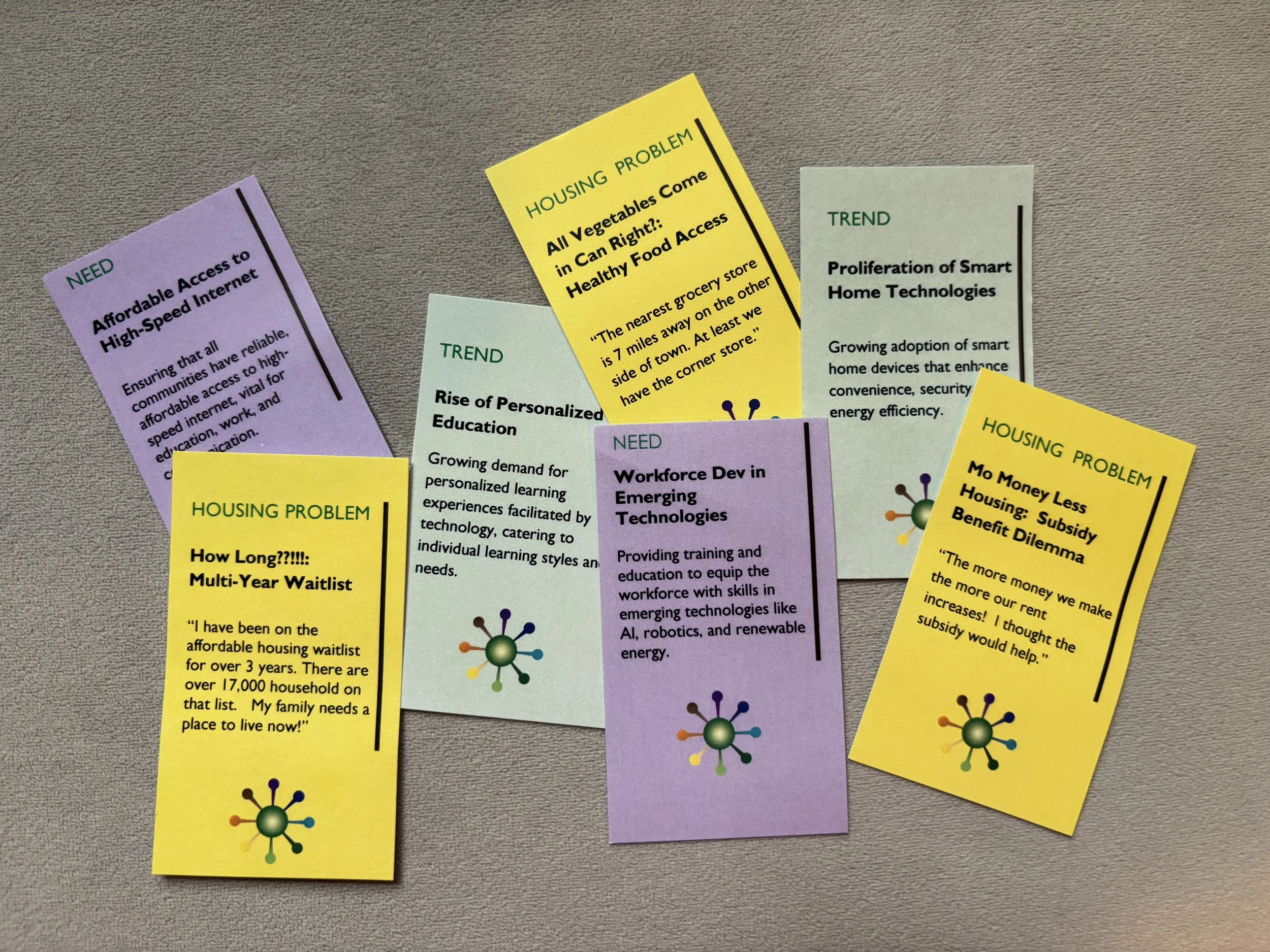
Exploring current needs, emerging trends, and signals of change can help reveal how today’s conditions might evolve.
Not every signal becomes important.
That is not the point.
The value is in developing the habit of looking beyond what is already obvious.
By the time a change is obvious to everyone, organizations are often reacting to it.
Earlier awareness creates more room to explore, prepare, adapt, and make choices.
Scenarios help us think beyond one expected future
Once we begin identifying forces of change and critical uncertainties, we can explore different ways the future might unfold.
This is where scenarios become useful.
A scenario is not a prediction.
It is a structured story about a plausible future environment.
What if trust in institutions increases?
What if it declines?
What if emerging technologies become broadly accessible?
What if access becomes increasingly concentrated?
What if resources become more abundant?
What if scarcity becomes a defining condition?
Different combinations of uncertainty produce very different operating environments.
And that is the value.
A strategy that looks excellent in one future may fail completely in another.
Scenarios allow leaders to ask:
How would our current strategy perform here?
What becomes more important?
What becomes less relevant?
What opportunities emerge?
Where are we vulnerable?
What would we wish we had started doing earlier?
The discussion often matters as much as the scenarios themselves.
Because it forces assumptions into the open.
Better foresight leads to better questions
Sometimes the most important outcome of foresight is not a new answer.
It is realizing we have been asking the wrong question.
A healthcare organization might begin with:
How will we serve more patients?
Foresight might lead to:
What if where and how people receive care changes fundamentally?
A university might ask:
What programs should we add?
A broader futures question could be:
What will learning, credentials, and expertise mean ten or twenty years from now?
A government agency might ask:
How do we improve this service?
Foresight might ask:
Will people need this service in the same way in the future—and what new needs might emerge instead?
Changing the question can expand the solution space.
That matters because organizations often spend significant time optimizing answers to questions the future may make obsolete.
The goal is not to create certainty
Leaders understandably want certainty.
Budgets have to be approved.
Teams have to be staffed.
Programs have to be launched.
Infrastructure has to be built.
Decisions cannot wait until we know exactly what will happen.
Strategic foresight does not eliminate that uncertainty.
It helps us make better decisions within it.
Instead of asking:
Which future should we bet everything on?
we can ask:
What would be valuable across several futures?
Those might be capabilities worth building now.
Instead of asking:
How do we protect this exact strategy?
we can ask:
Where do we need flexibility?
Those might be decisions we keep reversible.
Instead of asking:
What is the one solution?
we can ask:
What options should we create before we need them?
That is what future readiness can look like in practice.
Possible futures can reveal opportunities—not just risks
Futures work is sometimes treated primarily as risk management.
What could disrupt us?
What could go wrong?
What should we prepare for?
Those questions matter.
But they are only half of the work.
Exploring the future can also reveal opportunities that are difficult to see when we remain anchored to current conditions.
A constraint that seems permanent today may disappear.
A capability that seems peripheral today may become essential.
A population that is underserved today may represent a major opportunity to design something better.
Two technologies that appear unrelated may eventually converge.
A shift in behavior may create demand for an entirely new service.
A system that has operated one way for decades may become open to reinvention.
Foresight helps organizations ask not only:
What could threaten what we have?
but also:
What might become possible that is not possible today?
That question changes the posture from defense to exploration.
Preferred futures give us something to move toward
Not every futures question has to begin with external change.
Organizations can also ask:
What future do we actually want?
That is the idea behind a preferred future.
A preferred future is not a prediction or a guarantee.
It is a direction.
If leaders can articulate what they want a future system, organization, community, or experience to become, they can work backward.
What would have to be true?
What would need to change?
What capabilities would need to exist?
What relationships would need to strengthen?
What decisions would we need to make differently?
What should we begin now?
This is where foresight connects directly to strategy.
The future stops being an abstract horizon and becomes a way to examine choices in the present.
Foresight matters most when it changes a decision
A beautiful scenario report is not the goal.
Neither is generating the longest list of trends.
Foresight has value when it changes how an organization sees a problem, understands an opportunity, evaluates risk, invests resources, builds capabilities, or makes a decision.
That is why at Empact Global, we see foresight as part of a larger system of decision-making.
We use it to challenge assumptions.
To understand emerging change.
To widen the range of possibilities leaders consider.
To connect what could happen in the future to what organizations might do today.
And sometimes, simply to help people realize that the future they were planning for was only one of many possibilities.
The question is not:
Can we predict what comes next?
A more useful question is:
Can we make decisions today that leave us better prepared for whatever comes next?
That is the promise of strategic foresight.
Not certainty.
Better choices in the face of uncertainty.
EXPLORE FURTHER
What assumptions about the future are shaping the decisions you’re making today?
Empact Global helps organizations explore possible futures, challenge assumptions, identify emerging change, and translate foresight into strategic choices.